Activated Carbon Manufacturing
Carbon Activated Corporation produces activated carbon at its plants in Mount Hope, West Virginia, and Sri Lanka. The Mount Hope plant produces coal-based activated carbon, and the Sri Lanka plant uses a rotary kiln for steam activation. We also work with production partners in China, where some of the carbon we source is made in multiple-hearth furnaces.

How Activated Carbon Is Made
Raw Material Selection and Carbonization
Activated carbon is produced from coconut shells, coal, wood, and other carbonaceous materials. The choice of raw material helps determine the pore structure and physical properties of the finished activated carbon.
In the steam activation process, the first stage is carbonization. The raw material is heated in a low-oxygen environment. This thermal breakdown, known as pyrolysis, drives off volatile compounds and leaves a carbon-rich char for activation.
Steam Activation
At high temperatures, steam reacts with the char, opening and enlarging pores within the carbon. These pores provide the internal surface area where substances can be adsorbed.
The properties of the finished activated carbon depend on several factors, including:
- The type of raw material used
- The duration of activation and the reaction rate
- The reaction temperature
- The type and concentration of oxidizing gases
Activated Carbon Production Facilities
Mount Hope, West Virginia | Coal-Based Activated Carbon
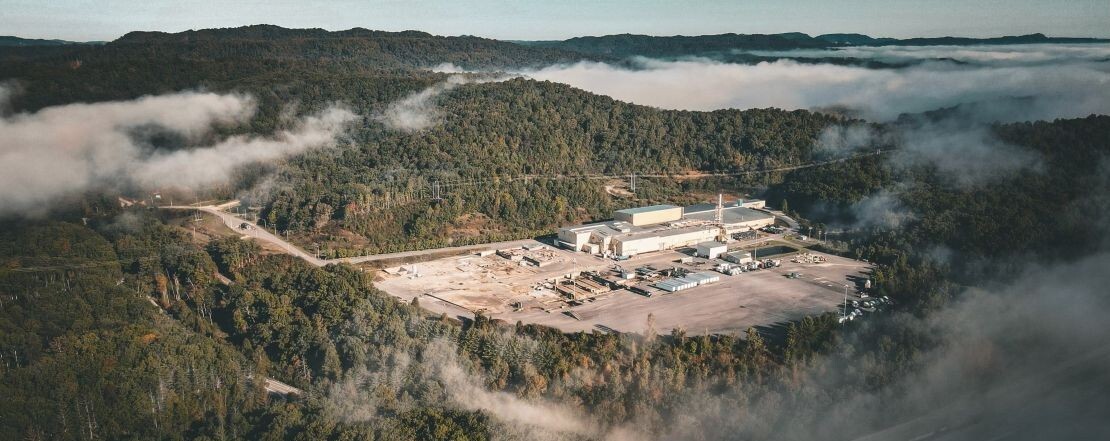
Carbon Activated operates a coal-based activated carbon manufacturing plant in Mount Hope, West Virginia. Located in the heart of West Virginia’s coal country, the facility strengthens our U.S. production capabilities and supports a reliable domestic supply of high-quality activated carbon.
The plant uses advanced processing technology to produce activated carbon designed to perform consistently across a wide range of applications. Explore our coal-based activated carbon grades.
Sri Lanka | Rotary Kiln Steam Activation

Our Sri Lanka facility uses a slowly rotating kiln lined with fireclay bricks. The kiln measures 20 meters long and 2.4 meters in diameter.
- Feeding and activation. A hopper continuously feeds carbonized material into the rotary kiln. As the kiln rotates, the material moves slowly downward. A blower feeds air into the kiln, and hot steam reacts with the char at approximately 900–1,100 °C. This reaction develops pores within the char, increasing the internal surface area available for adsorption. Activation takes approximately 25–40 minutes, depending on the temperature and oxygen level inside the kiln.
- Cooling. A screw conveyor fitted with a cooling jacket brings the carbon down to approximately 200 °C. The material then passes through a discharge pipe into a cooling kiln, where it cools further to approximately 30–40 °C.
- Sizing and packing. The cooled carbon goes through sizing equipment and is sorted by particle size. It is then packed into bulk bags for storage.
Multiple-Hearth Furnace Production in China

Some of the activated carbon we source from production partners in China is made in multiple-hearth furnaces. These furnaces produce high-grade activated carbon efficiently, with very little carbon loss. Each furnace has a vertical, cylindrical carbon-steel shell and measures approximately 15 meters tall and 6 meters in diameter.
- Feeding. A bucket elevator carries the charcoal to the top of the furnace.
- Activation. The material moves down through a series of rotating internal hearths. Each hearth is equipped with gas burners and steam injectors. Automatic controls regulate the burners and maintain temperatures of approximately 900–1,100 °C during activation.
- Cooling and screening. Heat exchangers cool the activated carbon as it leaves the furnace. Conveyors then carry it to screening equipment, and the screened material moves to silos for bagging and storage.
Quality Control During Production
We collect samples at several stages of production and test them in our laboratories. Sampling during production gives us a way to check material quality as it moves through the process.
After cooling, screening and sorting help bring the finished material within the specified particle-size range.
For more information about testing capabilities, see our activated carbon laboratory testing services.
Packaging Options for Finished Activated Carbon
Packaging depends on the product grade. Selected grades are available in 25 kg sacks, 500 kg bulk bags, or by bulk tanker. Check the product specification or contact our team to confirm the options for the grade you need.
Manufacturing FAQs
Steam activation is one method. Chemical activation is another and uses a chemical activating agent during heat treatment. The method depends on the raw material and the properties required in the finished carbon.
Activation runs at approximately 900–1,100 °C in our Sri Lanka rotary kiln and in the multiple-hearth furnaces used by some of our production partners in China.
In our Sri Lanka rotary kiln, steam activation takes approximately 25–40 minutes. The time varies with the temperature and oxygen level inside the kiln.
Particle size is the size of the carbon grains. Pore size is the size of the openings within each grain. Two grades with the same particle size can have different pore structures and adsorb substances differently.
Discuss Your Production or Product Requirements
If your specification calls for a particular raw material, particle-size range, production origin, or packaging format, contact our team to confirm the available options.
Click Here to Ask for a Quote