Advanced Activated Carbon Solutions for Water Purification
MOTIVATION
In an era where water quality challenges continue to escalate globally, activated carbon technology stands as a proven, versatile solution for removing contaminants from water systems. This technical guide explores advanced activated carbon solutions, examining the science behind adsorption mechanisms, comparing different carbon types, and demonstrating optimal applications across various industries.
ADSORPTION MECHANISMS
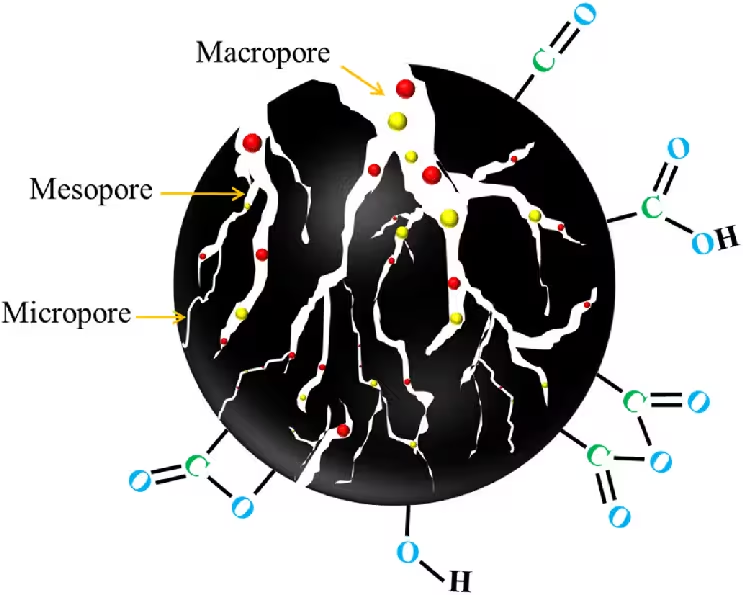
Activated carbon operates through physical adsorption, where contaminants are attracted to and held within the extensive pore network of the carbon matrix. The effectiveness depends on three critical factors: surface area (typically 500-1500 m²/g), pore size distribution, and chemical affinity between the carbon surface and target contaminants.
Physisorption – Physical adsorption into the pore structure.
- VOCs
Chemisorption – Chemical reaction an actual exchange of electrons, Common reactions are acid/base or oxidation/reduction mechanisms.
- H₂S
- NH₃
Catalysis – Surface catalyzed reactions where the surface chemistry is replenished with the constituents of the environment its in, (i.e., oxygen).
- Cl₂
- NH₂Cl
COAL-BASED ACTIVATED CARBON
Manufactured from high-grade bituminous coal through controlled carbonization and activation processes, coal-based activated carbon exhibits exceptional mechanical strength and a broad pore size distribution. The robust structure makes it particularly suitable for high-flow applications where particle attrition must be minimized. Its mixed pore structure (micro-, meso, and macropores) enables effective removal of both small and large organic molecules, making it ideal for municipal water treatment where diverse contaminant profiles are encountered.
Key Performance Characteristics
- Surface area: 800-1200 m²/g
- Iodine number: 900-1100 mg/g
- Apparent density: 0.45-0.55 g/cm³
- Ash content: ≤10%
- Hardness: ≥95%
COCONUT SHELL-BASED ACTIVATED CARBON
Derived from coconut shells through steam activation, this premium-grade carbon features a predominantly microporous structure with exceptional adsorption kinetics. The natural origin and low ash content make it particularly suitable for potable water applications. Its high microporosity (>90% of total pore volume) provides superior capacity for removing chlorine, volatile organic compounds, and taste/odor causing substances.
Key Performance Characteristics
- Surface area: 1000-1400 m²/g
- Iodine number: 1000-1200 mg/g
- Apparent density: 0.40-0.50 g/cm³
- Ash content: ≤5%
- Micropore volume: >0.35 cm³/g
WOOD-BASED ACTIVATED CARBON
Produced from sustainably sourced hardwood through phosphoric acid activation, wood-based carbon offers a balanced pore structure combining micro- and mesopores. This unique characteristic enables effective removal of both small molecules and larger organic compounds including pesticides, herbicides, and natural organic matter. The renewable feedstock aligns with environmental sustainability goals while maintaining high performance standards.
Key Performance Characteristics
- Surface area: 900-1300 m²/g
- Iodine number: 800-1000 mg/g
- Apparent density: 0.35-0.45 g/cm³
- Ash content: ≤7%
- Mesopore volume: 0.2-0.4 cm³/g
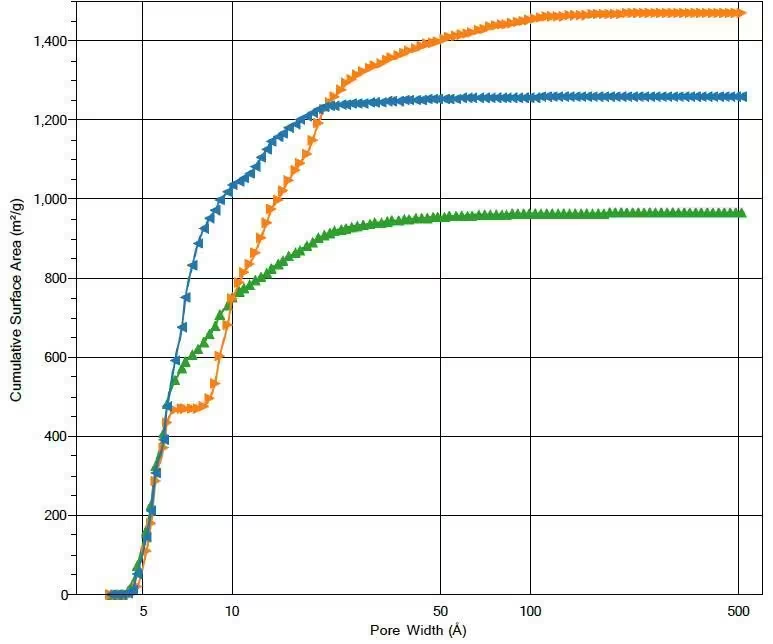
TABLE OF KEY ACTIVATED CARBON DIFFERENCES AND BEST APPLICATION PRACTICES
| Parameter | Coal-Based | Coconut Shell | Wood-Based |
|---|---|---|---|
| Primary Applications | Municipal water, industrial wastewater | Drinking water, pharmaceutical | Pesticide removal, color reduction |
| Optimal Contaminants | Chlorine, organics, taste/odor | VOCs, chloramines, small organics | Pesticides, herbicides, heavy metals |
| Mechanical Strength | Excellent | Good | Moderate |
| Cost Effectiveness | High | Premium | Moderate |
| Regeneration Potential | Excellent | Good | Limited |
WHY US?
Superior Adsorption Capacity
Our activated carbons are engineered with optimized pore structures achieving surface areas up to 1400 m²/g. Advanced activation techniques ensure maximum utilization of available surface area, resulting in higher contaminant loading capacities and extended service life.
Advanced Quality Control
Every batch undergoes comprehensive testing including iodine number, methylene blue adsorption, ash content, and particle size distribution. Our quality management system ensures consistent performance and compliance with international standards.
Rapid Adsorption Kinetics
Optimized pore structure and surface chemistry enable fast contaminant uptake, reducing required contact times and allowing for more compact system designs. This translates to reduced capital and operational costs.
Chemical Stability
Enhanced resistance to chemical degradation ensures stable performance across varying pH conditions and in the presence of oxidizing agents. This stability extends carbon life and reduces replacement frequency.
Customization Capability
Tailored activation processes allow us to optimize carbon properties for specific applications. Whether targeting pharmaceutical compounds, industrial chemicals, or natural organics, we can engineer solutions for your unique requirements.
Performance Monitoring
Comprehensive testing protocols and breakthrough monitoring systems ensure optimal performance throughout the carbon's service life. Real-time monitoring capabilities enable predictive maintenance and system optimization.
INDUSTRY APPLICATIONS AND CASE STUDIES
Municipal Water Treatment
In municipal applications, our coal-based GAC systems consistently achieve >95% chlorine removal while effectively controlling taste and odor compounds. Recent installations have demonstrated 18-24 month service life with proper pre-treatment, significantly exceeding industry averages.
Industrial Process Water
Pharmaceutical and electronics manufacturing facilities utilize our coconut shell-based carbon for ultra-pure water production. The low ash content and high purity ensure minimal contamination of sensitive processes while achieving >99.9% removal of trace organics.
REGULATORY COMPLIANCE AND CERTIFICATIONS
Our activated carbon products meet the industry/country specific regulatory requirements.
FUTURE INNOVATIONS AND EMERGING TECHNOLOGIES
The activated carbon industry continues to evolve with emerging contaminants and stricter regulatory requirements. Our research and development efforts focus on:
- Engineered Carbons: Surface modification for enhanced selectivity
- Hybrid Systems: Integration with advanced oxidation processes
- Smart Monitoring: IoT-enabled performance tracking and optimization
- Sustainable Production: Renewable feedstocks and energy-efficient activation
PARTNER WITH INDUSTRY LEADERS
Transform your water treatment challenges into opportunities with our advanced activated carbon solutions. Our technical experts are ready to collaborate on custom solutions that deliver superior performance, regulatory compliance, and operational efficiency.